Mazzini Square
Once called Antica Piazza Maggiore (lit. Ancient Main Square), today’s Piazza Mazzini (Mazzini Square) is the stage on which Guastalla’s most representative ducal, civic and religious buildings face one another. Its north, south and west sides are framed with porticoes, where sober lines lend the square both gravity and harmony, uniting a diverse range of structures into a coherent whole.
On the east side rises Palazzo Ducale (Ducal Palace), a compact and austere block, before which stands the bronze statue of Ferrante I Gonzaga, crafted by Leone Leoni, court artist to Emperor Charles V of Spain. The Duke, founder of the Guastalla branch of the Gonzaga family, is depicted trampling a satyr - symbol of vice - and severed head of a hydra - representing envy and slander. The statue alludes to the accusations of corruption and disloyalty to the emperor which Ferrante faced during his governorship in Milan. Once his innocence was proven, his son Cesare commissioned the work to commemorate the episode.
On the south side is the Palazzo della Comunità (Community Palace), also known as the Palazzo Municipale (Town Hall). It testifies to the sweeping urban and architectural redesign promoted in the 16th century by Dukes Ferrante and Cesare Gonzaga, family who then ruled over Guastalla since 1539. The works, led by Domenico Giunti of Prato and Francesco Capriani da Volterra, began in 1568-1569, in the newly created strategic Piazza del Mercato (Market Square), at the corner of the Strada Maestra (Main Road, today Via Gonzaga) the backbone of the town. The new “L”-shaped structure incorporated a preexisting building of the Torelli Counts, with its main entrance oriented towards the square and connected to the portico, the bustling hub of civic meetings and commercial exchanges - along the walls, measurement and weight boards can still be seen, once used to regulate trade.Today, as Guastalla’s Town Hall, it houses the council chamber, decorated with a monumental Romantic canvas depicting Count Ugolino, painted by Antonio Gualdi, a 19th century artist from Guastalla.
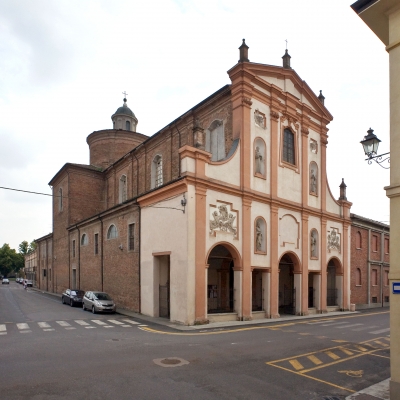
On the north side of the square stands the Concattedrale di San Pietro (Co-Cathedral of Saint Peter), commissioned in the 16th century by Duke Ferrante Gonzaga and designed by Volterra. It was consecrated in 1575 by Cardinal Carlo Borromeo, Archbishop of Milan and the Duke’s brother-in-law. Over the centuries, the church evolved from its original, simple structure with a plain façade, to the richly ornamented, Baroque-inspired form seen today. Inside, it preserves numerous sacred works of great historical and artistic value, including: the cedarwood statue of the Madonna del Castello (Madonna of the Castle), originally housed in the 15th-century fortress; Madonna col Bambino (Madonna and Child) by G.B. Crespi, known as Il Cerano (c.1620, oil on canvas); San Giuseppe con Gesù Bambino (Saint Joseph with the Christ Child) by Gerolamo Degiovanni (late 17th century, polychrome wood); San Francesco Riceve le Stimmate (Saint Francis Receiving the Stigmata) by Ludovico Ceroli known as Cigoli (late 16th century, oil on canvas); the Madonna del Rosario (c. 1655, polychrome wood).