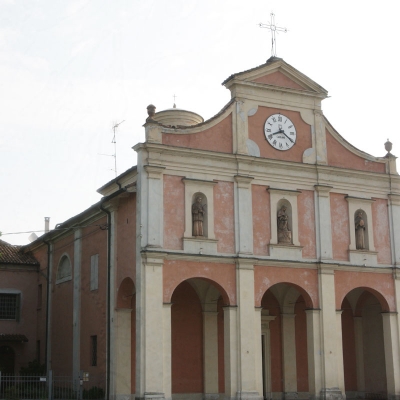
The Rocca of Novellara

Learn

The Rocca of Novellara

The Rocca is Novellara’s most representative monument.

Construction of this fortress - once the residence of the Gonzaga family - began toward the end of the 14th century and was completed about a hundred years later. In the 16th century, a series of renovations gradually transformed the stronghold into a Renaissance castle, better suited to court life than to defensive purposes. After the extinction of the Gonzaga line of Novellara in 1728, the Rocca was acquired by the Municipality in 1754.

Today, the building hosts both the Town Hall and  several cultural institutions: the Gonzaga Museum, the Theatre, the Library, and the Historical Archive. Inside, visitors can admire the Sala del Fico (Hall of the Fig), decorated with mid-16th-century grotesques; the Sala del Consiglio (Council Chamber), scenographically painted in the 19th century; the Sala Civica (Civic Hall), named after Augusto Daolio, where several of his drawings are displayed; and, in the attic of the east wing, the Acetaia comunale (municipal vinegar factory). The Rocca also houses the Mostra permanente della Civiltà Contadina (Permanent Exhibition of Rural Life). 

  • The Hall of the Fig (Sala del Fico)

Particularly remarkable is the grotesque ceiling of the Hall of the Fig (Sala del Fico), located on the Rocca’s ground floor. Its mid-16th-century frescoes, featuring allegorical, naturalistic and fanciful motifs, are attributed to Domenico Fredino and Giovan Battista Torbido. At the center of the vault and within the lunettes were scenes from the Parable of the Prodigal Son and the Story of Joseph, which were later removed in the 19th century. During restoration work, frescoes from the same period were also discovered on the walls. 

  • The Council Chamber (Sala del Consiglio)

The Council Chamber (Sala del Consiglio) is located in the northwest tower of the Rocca. In the 16th century this room served as a representative hall, known as the Salone Gonzaga (Gonzaga Hall), the Salone delle Aquile (Hall of the Eagles), or the Salone degli Specchi (Hall of the Mirrors). In the second half of the 19th-century, it was converted into the Council Chamber and scenographically decorated by Cesare Cervi, the same artist who adorned the Teatro Comunale (Municipal Theatre) in those years.

  • The Acetaia Comunale 

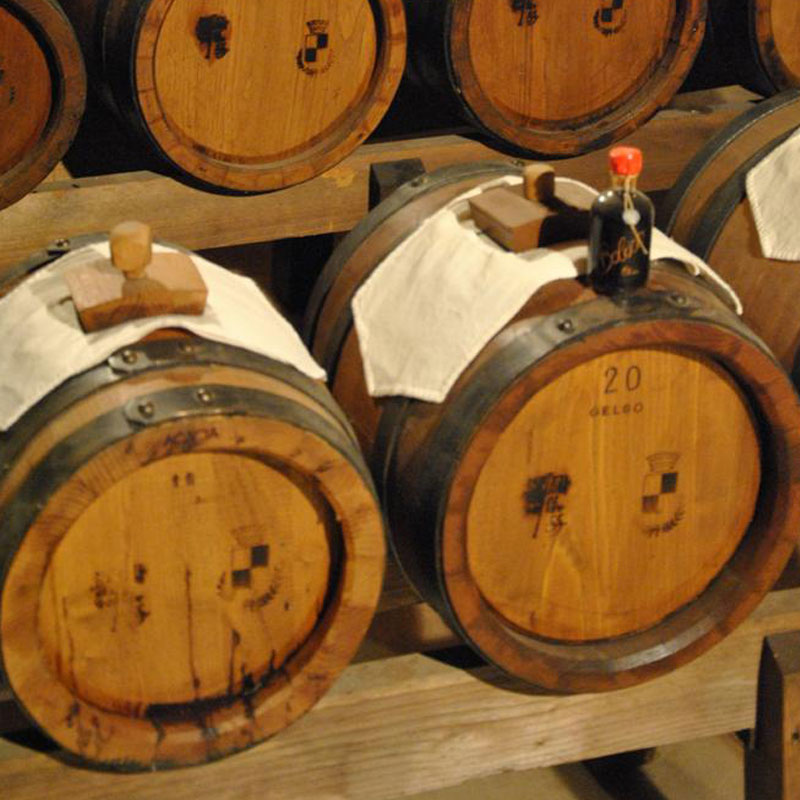
The Acetaia Comunale, where the precious Aceto Balsamico (Balsamic Vinegar) matures, is located in the attic of the east wing of the Rocca - now the seat of the Municipality, in the heart of the historical centre. Inside are two sets of fine barrels, each carefully branded with Novellara’s coat of arms. No detail is left to chance in the aging process: the number, capacity and sequence of the barrels are chosen by the Mastro Acetaio (Master Vinegar Maker) of the Confraternita dell’Aceto Balsamico (Balsamic Vinegar Confraternity). 

  • Permanent Exhibition of Rural Life (Mostra Permanente della Civiltà Contadina)

The Permanent Exhibition of Rural Life (Mostra Permanente della Civiltà Contadina), dedicated to Vittorio Ariosi, is housed in the evocative 15th-century underground rooms of the Rocca.

The exhibition was first set up in the early 1970s within the local middle school, as part of a student project researching the trades of their grandparents. The pupils collected numerous tools and implements once used in the countryside, as most of their grandparents had been farmers. The Exhibition was born from the commitment of the entire community, determined to preserve tangible evidence of its roots and pass it on to future generations. It highlights the profound connection between local culinary products - such as Lambrusco, Parmigiano Reggiano, cold cuts, watermelon, and honey - and the wisdom, skill and sensibility of ancient rural traditions.


CHIUSO TUTTO IL MESE DI AGOSTO
  • Historical Sites
  • Guided Tours

GALLERY

Nearby